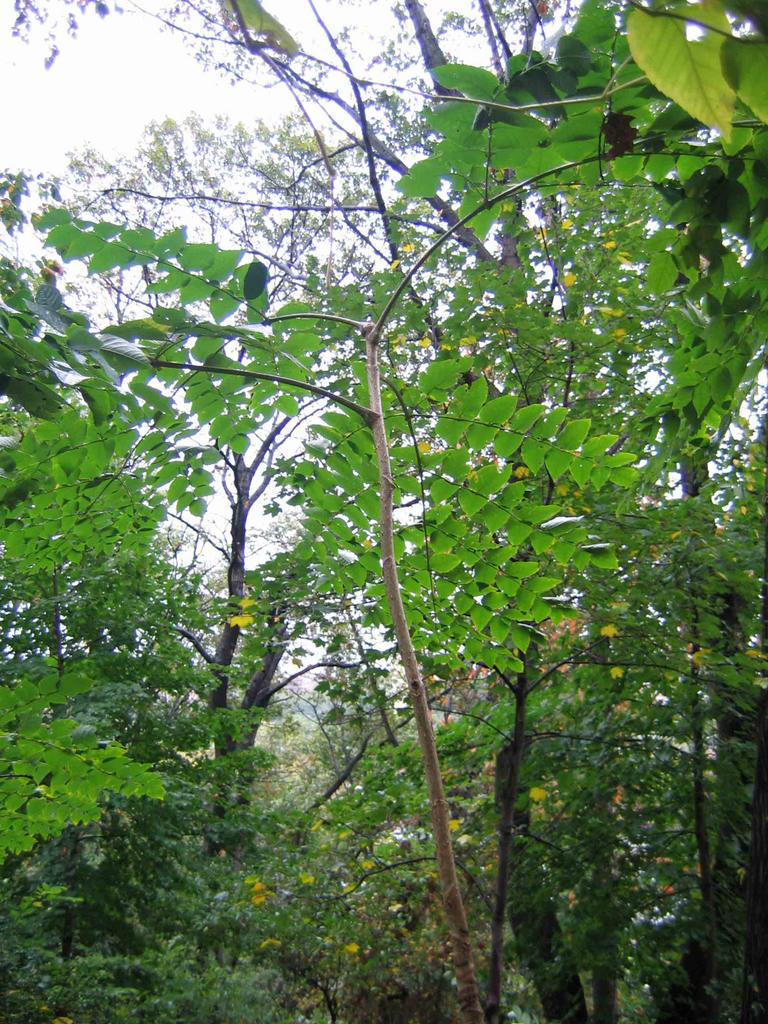
Japanese angelica tree (Aralia elata)??? Nice fall color, which I have never seen on (& reported doesn't exist for) the ubiquitous other Aralia.
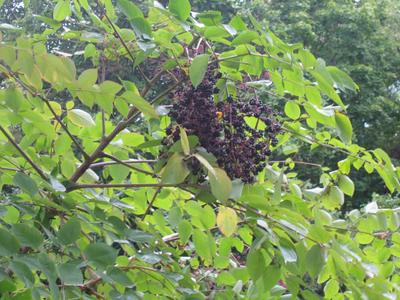 Japanese angelica tree (Aralia elata)??? with infructescence
 Devil's walking stick (Aralia spinosa)???
 Welcome to the world of botanical taxonomy. For your
entre, I thought we would go right for the jugular. Devil's walking stick
(Aralia spinosa) is native to the U.S. Most literature cites its range as Delaware & south (e.g., Gleason & Cronquist). One (Mitchell & Tucker) says it's native to New York State. So I called our
state botanist who assured me that G&C was right, it is not native to NY. In fact, field work has shown that there is no
A. spinosa in the state at all.
Everything we have been seeing is actually Aralia elata, an exotic invasive. There is a population of
Aralia spinosa out on Long Island, but that was shown to have piggybacked in on nursery stock from North Carolina.
So when a colleague of mine called me to say he had found an interesting
Aralia, I was excited. To compare, we began with the familiar.
We went to Highbridge Park in northern Manhattan. There was a small cluster of less than 10 shrubs in an opening in the forest canopy, not far off a trail. This is the Aralia shrub that I see all over NYC. It had dark green leaves held at almost a 90 degree angle to the main stem. We were calling this "spinosa"
based on the leaves - veination (joined before margin) & finely toothed, no obvious pubescence. The fruit panicles no longer held berries & had already whithered, so we didn't take a sample.
Now, the fun part. Next we went to Fort Washington Park, a subset of Riverside Park in northern Manhattan (around 158 St.). There were maybe 5 shrubs scattered along a stretch between a trail & fencing for the Metro North train line (so not obviously colonial like above). These plants were new to me - I had never seen this species before. We were calling this "elata" based on the leaves - veination (run to margin), broadly toothed & obvious pubescence. Additionally, these leaves were lighter green & held at a more acute angle to the midstem.
So we sent the samples to
Brooklyn Botanic Garden - I could barely get to sleep that night, I was so excited to hear back what the new-to-me plant was. Apparently they think they are both the same species...Aralia elata. They said what they really need is the point at which the inflorescence attaches to the main stem - that is the critical piece distinguishing one from the other. Oh. We didn't get that. But still, sometimes I think taxonomists are too by the book. Can't you just tell which is which? If I can ID species with just basal leaves, I expect a little more info when I provide such bounty.
And so the mystery continues..........
 OK, OK, I know. Don't go by leaves. Flowers/fruits are more stable, & so the basis of taxonomic determinations. But c'mon - these have to be two different species. (And additionally, if you aren't supposed to look at leaves, then why the difference between Smilax herbacea & S. pulverulenta (NYS rare) - the former has no hair on it's leaves, the latter has hair. Be consistent, people!)