Showing posts with label climate change. Show all posts

22 November 2006

866 Reports Can't be Wrong

Very depressing news just before the holiday...

WASHINGTON - Animal and plant species have begun dying off or changing sooner than predicted because of global warming, a review of hundreds of research studies contends.
These fast-moving adaptations come as a surprise even to biologists and ecologists because they are occurring so rapidly.

"We are finally seeing species going extinct," said University of Texas biologist Camille Parmesan, author of the study. "Now we've got the evidence. It's here. It's real. This is not just biologists' intuition. It's what's happening."

Her review of 866 scientific studies is summed up in the journal Annual Review of Ecology, Evolution and Systematics.

Parmesan reports seeing trends of animal populations moving northward if they can, of species adapting slightly because of climate change, of plants blooming earlier (remember our earlier post?), and of an increase in pests and parasites.

Read the rest here.

07 November 2006

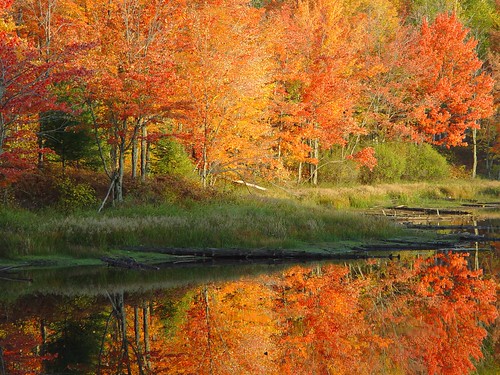
Autumnal Colors Head North


global warming and fall foliage

Say it ain't so!

Some climatologists have said that even if steps are taken now to limit global warming, temperatures in New England will rise enough over the next half-century that the source of much of that rich fall color, the sugar maples (Acer saccharum), will disappear from most of the region. Healthy stands of sugar maples may be found eventually no farther south than Canada and northern Maine.

04 November 2006

Herbaria aid climate change research

Haven't we been telling you that herbarium sheets are the foundation of all that is good and pure in the world? What is an herbarium sheet, you say? See this (then click on "store").


An old photograph shows that on Memorial Day, 1868, the deciduous trees in Lowell Cemetery in Massachusetts had yet to leaf out. On Memorial Day, 2005, they stood in full verdure. Leafing or flowering dates each year depend on temperature, and global warming has been driving those events earlier in many places. Plants take part in many ecological interactions—with their pollinators, for instance—that are precisely timed. Changes in their seasonal development may therefore bring on broader ecological disruptions. Records of past plant development are scarce, though, so analyzing trends in timing has been difficult.


Now Abraham J. Miller-Rushing and Richard B. Primack, both ecologists at Boston University et al. have compared dated historical photographs, as well as dated herbarium specimens, of plants in flower in eastern Massachusetts, with recent observations of the same species. The plants now flower about eleven days earlier than they did a hundred years ago, when the region was 4.5 Fahrenheit degrees cooler. Their findings echo independent estimates from other data, confirming that old photographs and herbarium specimens are reliable sources for climate-change research. (
American Journal of Botany, in press, 2006)

30 August 2005

Nature's Revenge

Editorial from today's New York Times

The damage caused by a hurricane like Katrina is almost always called a natural disaster. But it is also unnatural, in the sense that much of it is self-inflicted. New Orleans is no exception, and while the city has been spared a direct hit from the storm, its politicians and planners must rethink the bad policies that contributed to the city's vulnerability.

An immediate priority is for the Senate to restore some $70 million that the House, in a singular act of poor timing, slashed from the Army Corps of Engineers' budget for the New Orleans district. The cuts could hurt the corps' ability to rebuild levees protecting the city. Meanwhile, the city itself must attend to a pumping system that is much in need of upgrading.

At the same time, there must also be an honest recognition of the fact that no amount of engineering - levees, sea walls, pumping systems, satellite tracking systems - can fully bring nature to heel. Indeed, the evidence is indisputable that systematic levee-building along the Mississippi upstream of New Orleans has blocked much of the natural flow of silt into the delta. That, in turn, has caused the delta to subside and made the city and its environs even more vulnerable to the waters of the Gulf of Mexico, which itself has been rising.

Upstream levee-building has also had the effect of turning a sluggish river into a fire hose, helping to destroy marshes and barrier islands that once provided some protection. The steady destruction of coastal wetlands by residential development and years of oil and gas drilling hasn't helped much either. The combination of subsiding land and rising seas has put the Mississippi Delta about three feet lower than it was 100 years ago.

All this, in turn, lends urgency to plans proposed by Louisiana politicians to restore natural hurricane protections by diverting water and silt from the river to coastal marshes and wetlands, and by rebuilding barrier islands. The effort is expected to take more than 40 years and cost an estimated $14 billion, substantially more than the $8 billion Everglades restoration project.

The administration budgeted $20 million for the project this year, mainly for the necessary planning studies. A lot more than that is going to be needed. New Orleans must learn to take care of nature if it hopes to survive it.