Showing posts with label queens. Show all posts

02 February 2007

Arverne by the Sea, Queens

I had heard a lot of hoopla about Arverne by the Sea, we got there and it was a pretty big letdown. The neighborhood itself is really depressing, very impoverished. I've been all over the city, but I've never seen anything like it. It was like being in a desolate Rust Belt town.

A view down the boardwalk. Bayberry in foreground, lots of shore little bluestem in background.


Northern bayberry (Myrica (Morella) pensylvanica) holds onto some of it's leaves through winter, although you can see quite a few on the ground. Lovely russet color. The fruits are harder to see but they are there. They have a high lipid content - excellent nourishment for migrating birds. Arverne, Queens.

A view towards the A train tracks


Golden hues of shore little bluestem (Schizachyrium littorale)


Northern bayberry (Myrica pensylvanica) leaves blanket the ground, shading out grass seedlings. The shrubs are also colonial, meaning they reproduce vegetatively. These strategies enable bayberry to succeed switchgrass, little bluestem et al in maritime/coastal grassland communities. It's also a great wintry color palette: gold, russet, gray.

01 February 2007

Urban Blight Botanizing at Dubos Point

Salt marsh cordgrass (Spartina alterniflora) culms with sea lavender stems (Limonium carolinianum).

Poor Dubos Point. I found a reference to it as a site for "Urban Blight Birding" . This is too bad, since the 33-acre site is named in honor of Dr. Rene Dubos, he of the great phrase, “Think globally, act locally.” And while the spirit of this sentiment seems to have been lost on the NYC parks dept, that is probably a good thing. Their neglect often leads to more natural area. Parks targeted for "improvements" get excessive amounts of the built - boardwalk, trail, birdblinds while simultaneously diminishing the natural - incursion of invasive plants from disturbance and construction vehicles, loss of rare plants due to uninformed site design.

I should do more yoga - this frustration has to seep out somehow.


Just across from JFK...

Back to my site visit. Dubos Point was a saltwater marsh until 1912, at which point it was filled with dredged materials for real estate development. The project failed to materialize. Today, it is the largest salt marsh on the north shore of the Rockaway peninsula east of Rockaway Point.


High tide line with felled Spartina alterniflora, groundsel bush (Baccharis halimfolia) and marsh-elder (Iva fructescens). And, of course, detritus. This is urban blight botanizing, after all.


More floatsam. The most interesting thing is the coconut. I wonder if that came from nearby garbage, or instead from some tropical paradise. It's not unheard of, those suckers travel far. They've been found off the coast of Ireland. Today I counted 5 coconuts!

Some of the plants seen in the salt marsh areas:

Graminoids -
salt grass (Distichlis spicata), blackgrass (Juncus gerardii), common reed (Phragmites australis), salt marsh cordgrass (Spartina alterniflora), salt meadow cordgrass (Spartina patens).
Shrubs -
groundsel bush (Baccharis halimfolia) and marsh-elder (Iva fructescens).
Forbs - sea rocket (Cakile edentula), sea lavender (Limonium carolinianum), glasswort (Salicornia europaea), seaside goldenrod (Solidago sempervirens).

In addition to salt marsh, we also saw maritime grasslands. Both of these vegetative communities are rare in NYC.


28 September 2006

Plants 0, Recreation 1

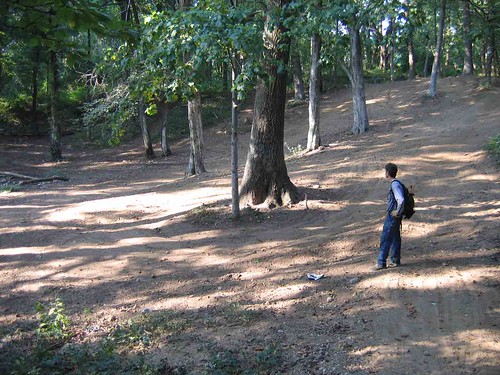
This is a charming little change in Parks' policy from allowing only passive recreation to now installing mountainbike trails in natural areas throughout the city. These pictures are from Cunningham Parks in Queens. I have a couple of issues, aside from how devastating this will be to ferns and wildflowers of the forest floor.

The propaganda (which, please note, was written by the mountainbike person doing this work), speaks of erosion:

"There's a common misconception that bicycles cause erosion damage to the trails. In response, a group of local mountain bicyclists decided to band together and educate themselves on the science of trail erosion and how bicycles could be ridden with minimal impact. Fueled with information provided by the International Mountain Bicycling Association (IMBA) and the US Forest Service, a management plan began to take shape."

First, I would like to see the literature that supports the contention that mountainbikes don't erode trails. But that will never happen. You know why? It doesn't exist. You can, I imagine, minimize erosion, but there will always be erosion associated with mountainbiking.

Second, you want to see their answer to erosion? Look below...


That ditch off to the side? THAT is the result of their managment plan. These are placed every so often along the trails where there are slopes to encourage water (and thus water borne entities, such as soil) to pool. There is still plenty of erosion happening. What is no longer happening is the soils ending up on sidewalks and roadways when it rains. Now the soil settles into these little pools. So it keeps civic infrastructure tidy, but does nothing to retain the uppper soil layers. aka the seed nursery aka the bed of all future trees.


This is utterly awful. Acres and acres of destruction caused by all terrain vehicles - those off road motorized contraptions. Cops tell the drivers to go in the parks - these things are illegal on city streets. But see what happens when cops send these guys into the woods? This is a living graveyard. Once those trees die, nothing will take their place. Shameful. Why doesn't the Parks Department put in perimeter protection to keep these vehicles out? It's a cheap and easy solution, but there is obviously no will.