Showing posts with label salt marsh. Show all posts

01 February 2007

Urban Blight Botanizing at Dubos Point

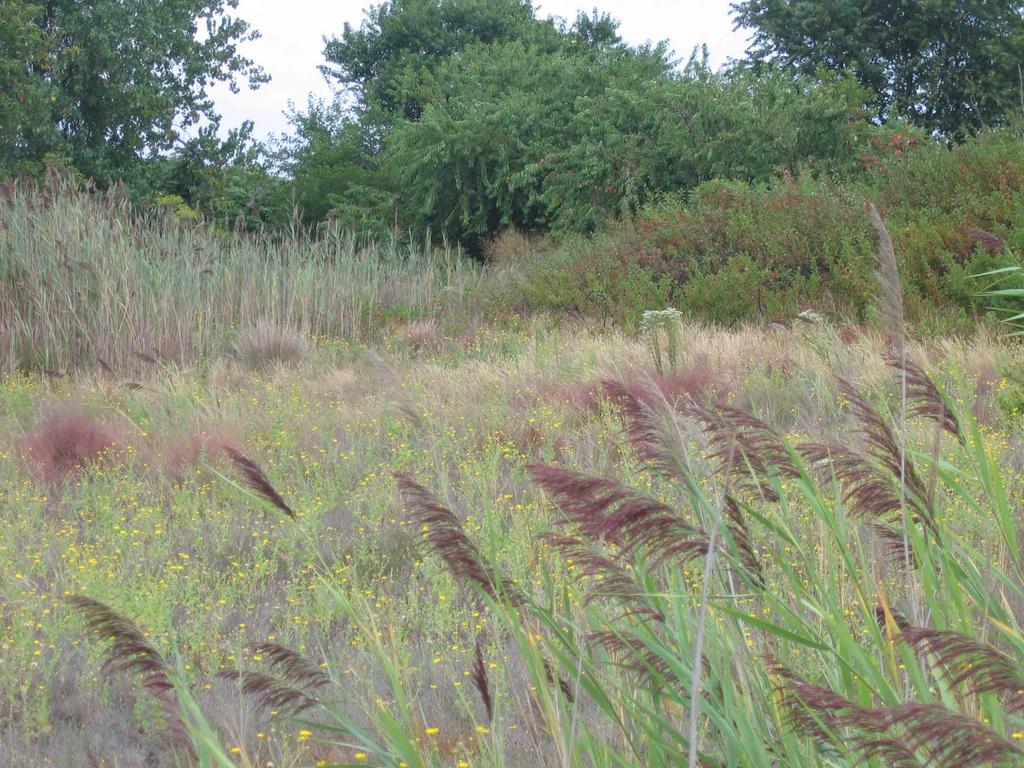
Salt marsh cordgrass (Spartina alterniflora) culms with sea lavender stems (Limonium carolinianum).

Poor Dubos Point. I found a reference to it as a site for "Urban Blight Birding" . This is too bad, since the 33-acre site is named in honor of Dr. Rene Dubos, he of the great phrase, “Think globally, act locally.” And while the spirit of this sentiment seems to have been lost on the NYC parks dept, that is probably a good thing. Their neglect often leads to more natural area. Parks targeted for "improvements" get excessive amounts of the built - boardwalk, trail, birdblinds while simultaneously diminishing the natural - incursion of invasive plants from disturbance and construction vehicles, loss of rare plants due to uninformed site design.

I should do more yoga - this frustration has to seep out somehow.


Just across from JFK...

Back to my site visit. Dubos Point was a saltwater marsh until 1912, at which point it was filled with dredged materials for real estate development. The project failed to materialize. Today, it is the largest salt marsh on the north shore of the Rockaway peninsula east of Rockaway Point.


High tide line with felled Spartina alterniflora, groundsel bush (Baccharis halimfolia) and marsh-elder (Iva fructescens). And, of course, detritus. This is urban blight botanizing, after all.


More floatsam. The most interesting thing is the coconut. I wonder if that came from nearby garbage, or instead from some tropical paradise. It's not unheard of, those suckers travel far. They've been found off the coast of Ireland. Today I counted 5 coconuts!

Some of the plants seen in the salt marsh areas:

Graminoids -
salt grass (Distichlis spicata), blackgrass (Juncus gerardii), common reed (Phragmites australis), salt marsh cordgrass (Spartina alterniflora), salt meadow cordgrass (Spartina patens).
Shrubs -
groundsel bush (Baccharis halimfolia) and marsh-elder (Iva fructescens).
Forbs - sea rocket (Cakile edentula), sea lavender (Limonium carolinianum), glasswort (Salicornia europaea), seaside goldenrod (Solidago sempervirens).

In addition to salt marsh, we also saw maritime grasslands. Both of these vegetative communities are rare in NYC.


11 January 2007

Soundview Park, BX

Today I visited Soundview Park, targeting specific sections to see if there was any vegetation of interest. Most of the sections I looked at were fill soils with mugwort (Artemisia vulgaris) as the dominant species - exotic, invasive, nada.

The area that had the most interesting vegetation was the jetty. My presumption is that the jetty is similar to high quality (clean) sandy fill - no nutrients, no weeds.
Soundview Park is in the south Bronx, where the Bronx River opens into the East River. This sections is estuarine, meaning the water is brackish. The salinity levels of the Bronx River diminish (becomes freshwater) a little further north, near the Bronx Zoo. So, as expected, much of the vegetation I saw was typical of salt marsh/maritime areas. The grounsel bush (Baccharis halimifolia) and marsh elder (Iva fructens) seen above are testament to the presence of saltwater. It was a rather nice saltmarsh, small, and no botanical surprises.
Seaside goldenrod (Solidago sempervirens)


The park has been derelict for so long the the locals feel comfortable squatting on city land, whether for boats...


Or the dead. Dead what? I don't know. I don't think I want to know. After we passed the memorial, there was a wretched smell - a giant, rotting dead dog. People, I don't make this stuff up.

28 August 2005

White Island Plant Walk


This is the chronicle of the rest of my day in Marine Park, where I was to lead a Torrey Botanical Society plant walk.

White Island is a 73-acre former sand bar in the middle of Marine Park Creek. From the 1940s to 1960s, the site was built up through the addition of household garbage and sand. Areas with little sand cover and thus high levels of nutrients support Phragmites and mugwort. Note the sand bags in the photo below - these were put in place to keep the household garbage, the structural foundation of the island - from washing away.


The sections of the island harboring stockpiled sand today support a diverse array of grassland plants. But to get there, you have to hack your way through what seems like miles of Phragmites. It seemed like miles because I am sure it was miles...but only because my sense of direction was off. It took me quite a while to relocate the open grassland.

But finally I did. And it was like discovering a wonderland.

Eragrostis spectabilis, purple love grass


Pseudognaphalium obtusifolium, sweet everlasting


Solidago juncea, early goldenrod

Plants of White Island in Marine Park, Brooklyn (partial flora)
Torrey Plant Walk August 28, 2005

Typical Native Grassland Species

HERBS – Flat-topped goldenrod (Euthamia tenuifolia), sweet everlasting (Gnaphalium obtusifolium), pinweed (Lechea maritima), jointweed (Polygonella articulata), saltwort (Salsola kali), early goldenrod (Solidago juncea), seaside goldenrod (Solidago sempervirens);

VINES - northern dewberry (Rubus flagellaris);

GRASSES – beach-grass (Ammophila breviligulata), big bluestem (Andropogon gerardii), 3-awn grass (Aristida tuberculosa), purple love grass (Erigrostis spectabilis), panic grass (Panicum villosissimum), switchgrass (Panicum virgatum), little bluestem (Schizachyrium scoparium);

SHRUBS – false heather (Hudsonia tomentosa), northern bayberry (Myrica pensylvanica), winged sumac (Rhus copallinum), poison ivy (Toxicodendron radicans).

OTHER SPECIES FOUND (* = exotic, ! = invasive)

HERBS – common ragweed (Ambrosia artemisiifolia), Indian hemp (Apocynum cannabinum), mugwort (Artemisia vulgaris)*!, common milkweed (Asclepias syriaca), spotted knapweed (Centaurea maculosa)*, horseweed (Conyza canadensis), winged pigweed (Cycloloma atriplicifolium)*, white snakeroot (Eupatorium rugosum), bedstraw (Galium mollugo)*, camphorweed (Heterotheca subaxillaris)*, yellow wood sorrel (Oxalis stricta), pokeweed (Phytolacca americana), lady's thumb (Polygonum persicaria)*, sheep sorrel (Rumex acetosella)*, horse-nettle (Solanum carolinense)*, black nightshade (Solanum nigrum)*, sand spurrey (Spergularia rubra)*, common mullein (Verbascum thapsus)*;

VINES – hedge bindweed (Calystegia sepium), Oriental bittersweet (Celastrus orbiculata)*!, Virginia creeper (Parthenocissus quinquefolia);

GRASSES – silver hairgrass (Corynephorus canescens)*, common reed (Phragmites australis)*!;

SHRUBS – Japanese barberry (Berberis thunbergii)*!, autumn olive (Elaeagnus umbellata)*!, wrinkled rose (Rosa rugosa)*;

TREES – tree of heaven (Ailanthus altissima)*!, white mulberry (Morus alba)*!, black cherry (Prunus serotina), green ash (Fraxinus pensylvanica).

Unprepared


I always do this. I talk myself out of bringing along some obviously essential item because my field pack is too heavy. That is how I ended up this morning at the salt marsh of Marine Park without my boots.

To be fair, I had planned to stay out of the marsh itself, checking out the flora that rimmed the wet areas. I have seen Spartina alterniflora often enough that I could go without an up-close-&-personal viewing. What I didn't plan on was a poacher.

In the midst of my vegetative reverie, a middle-aged Asian man with a hand cart filled with tools & bags walked confidently by me. Suspicious. Sure enough, he proceeded to walk into the muck, pull out a tool & rake the marsh for mollusks. As you may have suspected, removal of anything from a park is illegal, especially the very animal life we are trying to conserve.

"Sir, I'm sorry, but you can't do that."
Nothing
"Excuse me, sir, you can't do that!"
Now he looks at me & smiles.
"Sir, you will have to stop that! You aren't allowed to do that!"
He shrugs his shoulders & gives me this look like he doesn't know what I'm talking about. So then I was reduced to repeating "No!" & "Stop!" while I walked out after him. I tried to stay dry, hopping from tussock to tussock, but that became futile after 5 minutes, when I slipped & went in to my knee. That's the thing with muck, you never know how deep it is.

By the time I reached him, he had out what I swear was a harpoon & was jabbing the water vigorously. He seemed to finally get it, & proceeded to leave without more protestation from me. As I climbed out of the low marsh, I watched him leave, cart in tow. I was so satisfied in having put an end to a poacher. I felt good.

Ten minutes later, I was in the nature center. This is a nice building which takes full advantage of the superb views with its large windows. As I was admiring the marsh, in the distance I saw a blue speck moving purposefully along the edge of the Spartina grasses.


03 May 2005

Old growth & salt marshes in Pelham

I don't know what it is about Pelham Bay Park, but lately I feel like I live there. Not that I am complaining. Anyway, had a field meeting out there and went to part of the park that I had never been to before. It was like the enchanted place Olivia Newton John sang about in "Xanadu". But more on that later.

Mockernut (Carya tomentosa), a NYC native tree, leaves emerging with ants.

First we walked through some old growth forest on Hunter Island. I know, everyone tells you there is no old growth forest in New York City. Well honey, you can now tell your friends they are all washed up. Here is the proof...

tulip tree (Liriodendron tulipfera) trunk

See how the bark on the tulip tree is at the base, how it's broken up? That is a sign of old growth in trees. "Old growth" is defined as >150 years, although I think tulip trees may reach the fissured bark stage earlier, around 125 years or so. But you get the point - OLD.


dwarf serviceberry in flower - native and uncommon in NYC - very cool!
So back to Xanadu. We walked out over the salt marsh to one of the many outlying islands, and it was breathtaking (except for the scary vodoo doll found by Erik Kiviat). Here was a sandy soil community of juneberries, sassafras, heath shrubs, panicled hawkweed and gall-of-the-earth. This was the first time I had seen dwarf serviceberry (Amelanchier spicata), found in only 3 parks in the city. I was reveling in it - a pristine, untouched chunk of nature. Ha! the other side of the island had this...

I couldn't believe it! After I stopped ranting, I thought, well, at least these homeless folks have a little hobby. Later I found out that they are not homeless, but local old Italian guys who think the park is their private property. Warning to the old men, I am watching you.