29 September 2005

Botanists battle aliens in Acadia park

The plant busters, an elite team of national park botanists, had come to the Great Meadow on a whirlwind mission to search and destroy some of the alien, invasive species that have put down stubborn roots in the park.

"The more you look, the more you see," Betsy Lyman of the Northeast Exotic Plant Management Team said while pointing out an undulating green sea of alder buckthorn saplings. "It's an endless task."
The scrubby alder buckthorn saplings immigrated from Europe sometime after the 1800s, she said.

They spread rapidly and may be detrimental to the local wildlife in part because their large purple berries are attractive to birds but don't provide nearly the amount of nutrition that Maine's native berries, like the winterberry, do.

"For birds, it's kind of like eating junk food," Linda Gregory, Acadia National Park botanist, said. "This is not great wildlife food."

Read the full article from the Bangor Daily News

24 September 2005

Phrag in Iraq


With all of the bad news spewing forth from Iraq, I thought it might be time to post this. Phragmitis australis or "common reed" is one of the most invasive plant species in the northeast. Toiling diligently to destroy it, in this country restoration workers use mechanical & chemical means to squelch its vigor. Maybe we should take a page out of the Iraqi notebook. There, it is native & is used by Iraqis living in the northern marshes to build boats, housing, and temples. The temple in the photo below is said to be cool even at noon in the desert.


An article from NY Times in March on restoring the marshes of northern Iraq that were destroyed by Saddam Hussein.

More about Phragmites australis in the U.S.

22 September 2005

Stalking the Wild Orchid

Sadly, wild plant pilfering happens all the time. People can be stupifingly self-centered & just plain evil when it comes to rare vegetation - as chronicled famously in The Orchid Thief. But maybe too I am a little more trusting, I didn't ask the NY Times reporter to don a blindfold.

Here, garden writer Ken Druse takes a walk with the Nature Conservancy in the Pine Barrens of New Jersey...and I am jealous.Read more

19 September 2005

Guess what I found!

Somewhere in Van Cortlandt Park in the Bronx...

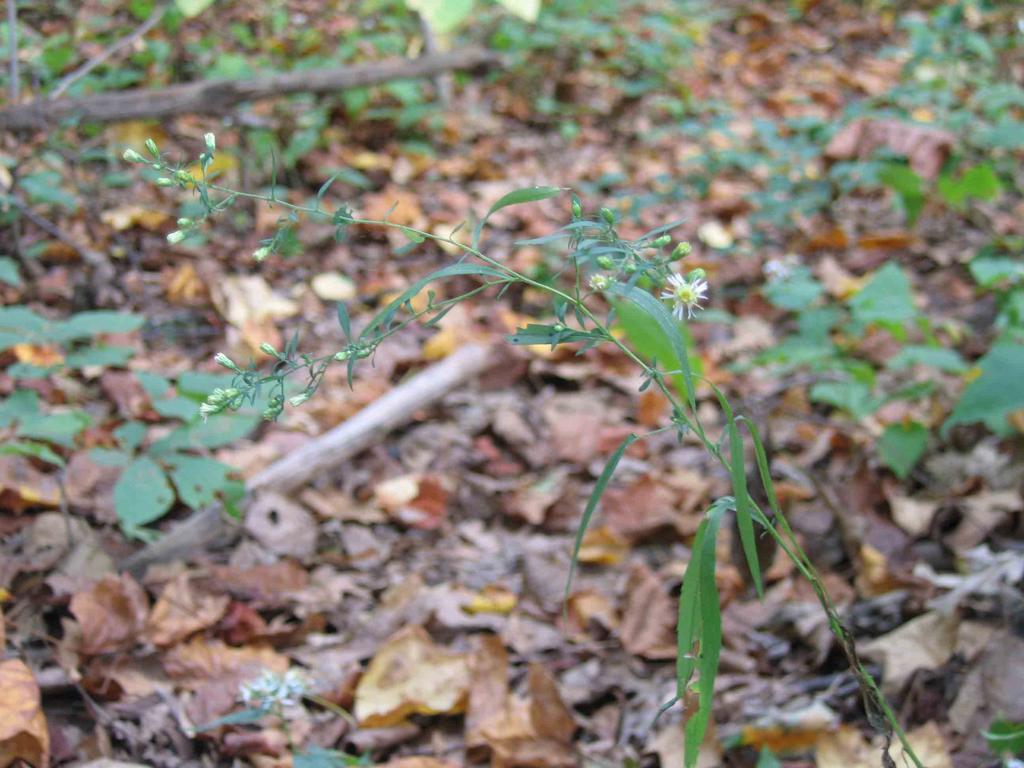
Schreber's aster (Eurybia schreberi {formerly Aster s.})
This native species has adapted to life on forest floors by being colonial. That is, it reproduces vegetatively, producing a leafy carpet. When it's happy, it will put up flowers, which are white. Easily confused with large-leaved aster (E. macrophylla), which has light blue blooms. But let's say you missed the boat on the flowers, as I did...what to do? Examine the basal leaves closely. Both species have heart-shaped bases. However, in E. schreberi, if you spread the bases, there is a rectangular shape between the lobes. Large-leaved is simply heart shaped. Obscure? You bet. That's why we botanists make the big bucks. It's important to differentiate between the two, since Schreber's aster is rare in New York State. Both species are uncommon in NYC.


Rough-leaved goldenrod (Solidago patula)
But that was just a teaser. I knew that plant was there. The "guess what I found" is this goldenrod. "They are a dime a dozen," you are thinking. Friend, you would be wrong.

Sure, Canada, early, gray, and rough-stemmed are common along roadsides and in old fields. Even seaside goldenrod isn't limited to its namesake habitat. But S. patula is one of the fabled "wetland goldenrods", which makes it unusual & rare in NYC. I had never seen it.

I found it quite by accident, as is the case with the best botanical finds. I knew it was a special goldenrod, and so marked the spot to return the next day. I came back armed with my Gleason & Cronquist and Britton & Brown. When it keyed out to S. patula, it felt as though I had just won a prize - a new find for the city!


14 September 2005

Good Gardening: Maidenhair Fern

Maidenhair fern (Adiantum pedatum). Note that even
ferns have some color to offer the garden palette come fall.


The lovely maidenhair fern (Adiantum pedatum) is a wonderful addition to a shady garden spot. Its delicate foliage whorled atop wiry black stems nicely complements broad-leaved wildflowers. The fern grows to 3 ft., producing spores in July-August, which is the best way to get new plants. It does reproduce vegetatively, but very slowly.

It's natural habitat is rich moist woods and streambanks, in circumneutral soil.
In your garden, this plant does best in well-drained, moist, organic soils - or a comparable situation that mimics its wild environs as much as possible. That said, it isn't terribly fussy. Its whispy demeanor belies its toughness - it can withstand variable situations as witnessed below in this front yard in Brooklyn.

12 September 2005

HGG: Beach Plum

Beach plum (Prunus maritima) in fruit

Time for another installment of "Home Grown Greenery". I am partial to beach plums, for a number of reasons. As the name implies, this shrub haunts seaside dunes, and who doesn't like the shore? Due to the salt spray, the shrub develops branching patterns that resembles sculptured hewn from dark bark. It eventually creates large, suckering colonies that may reach 6 ft. in height. In spring, before the leaves unfurl, the branches are awash in scented white blooms & ecstatic insects. It's quite a spectacle for a plant whose natural surroundings are so spartan. Each individual blossom has five petals & numerous stamens, as do all members of the rose family (Rosaceae). By fall, these develop into dark blue fleshy fruits that are edible, but you must be quick! Birds also like plums. (To guarantee fruit set, plant more than one shrub.)

Along with other Prunus species, beach plum is the preferred larval host plant for several species of swallowtail butterflies (Papilio), along with the coral hairstreak (Harkenclenus titus), viceroy admiral (Limenitis), and spring azure (Celastrina argiolus).

Black knot (Apiosporina morbosa) is common on Prunus species. It is more aesthetically displeasing than deadly to the plants. Here are excellent photographs & a perkier review of the fungal infection.

The species is endangered in Connecticut and Pennsylvania. More about beach plum.

30 August 2005

Nature's Revenge

Editorial from today's New York Times

The damage caused by a hurricane like Katrina is almost always called a natural disaster. But it is also unnatural, in the sense that much of it is self-inflicted. New Orleans is no exception, and while the city has been spared a direct hit from the storm, its politicians and planners must rethink the bad policies that contributed to the city's vulnerability.

An immediate priority is for the Senate to restore some $70 million that the House, in a singular act of poor timing, slashed from the Army Corps of Engineers' budget for the New Orleans district. The cuts could hurt the corps' ability to rebuild levees protecting the city. Meanwhile, the city itself must attend to a pumping system that is much in need of upgrading.

At the same time, there must also be an honest recognition of the fact that no amount of engineering - levees, sea walls, pumping systems, satellite tracking systems - can fully bring nature to heel. Indeed, the evidence is indisputable that systematic levee-building along the Mississippi upstream of New Orleans has blocked much of the natural flow of silt into the delta. That, in turn, has caused the delta to subside and made the city and its environs even more vulnerable to the waters of the Gulf of Mexico, which itself has been rising.

Upstream levee-building has also had the effect of turning a sluggish river into a fire hose, helping to destroy marshes and barrier islands that once provided some protection. The steady destruction of coastal wetlands by residential development and years of oil and gas drilling hasn't helped much either. The combination of subsiding land and rising seas has put the Mississippi Delta about three feet lower than it was 100 years ago.

All this, in turn, lends urgency to plans proposed by Louisiana politicians to restore natural hurricane protections by diverting water and silt from the river to coastal marshes and wetlands, and by rebuilding barrier islands. The effort is expected to take more than 40 years and cost an estimated $14 billion, substantially more than the $8 billion Everglades restoration project.

The administration budgeted $20 million for the project this year, mainly for the necessary planning studies. A lot more than that is going to be needed. New Orleans must learn to take care of nature if it hopes to survive it.