Showing posts with label spring ephemerals. Show all posts

29 April 2007

Freaky ramps

Today I was back at Corson's Brook Woods in Staten Island for my Torrey plant walk. I came across this: Ramps (Allium tricoccum) with a spooky white stripe. Prematurely grey from worry over site development? The state did want to build on the site. It's actually probably from a virus. I know some plants in the horticultural trade, such as tulips, have viruses introduced to created patterns on petals or leaves.


Gratuitous wildflower photo of downy yellow violet (Viola pubescens).

28 April 2007

Sourland Mountains, NJ

All this rain is ruining my plant walks! I've been looking forward to the Raritain River floodplain walk on Torrey Botanical Society's field trip page. Bluebells, bluebells, and bluebells. They are really just gorgeous. And, for some reason, not in New York. So, I would've gotten my fix if it hadn't rained. And I hadn't gotten lost. Instead, I went to Sourland Mountain Nature Preserve.

Early saxifrage
(Saxifraga virginiensis) on a muddy lump. Note the hairy stems. These sticky stalks protect its precious nectar and pollen from maurading non-pollinators such as ants.

Pennywort
(Obolaria virginica) is an interesting wildflower with its reduced, scale-like leaves. This species is no longer found in NYC.

Emerging rattlesnake fern
(Botrychium virginianum). A persnickety fern, a good indicator of ecological integrity, due to its relationship with mycorrhizal fungi. This species is rare in NYC.
Wild licorice leaves (Galium circaezans)

Jack in the pulpit (Arisaema triphyllum) with deep burgundy stripes on spathe, which acts as an umbrella for the spadix, the actual inflorescence hiding inside which bears tiny blossoms.

23 April 2007

Corson's Brook Woods 07

Last year was my first time at Corson's Brook Woods, and it made a big impression on me - such a mecca of spring wildflowers! So, I visited again this year and it did not disappoint.

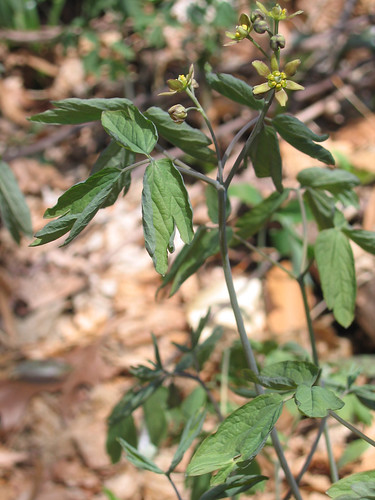
Blue cohosh
(Caulophyllum thalictroides). A striking spring ephemeral, with its unusual flower color and greyish blue glaucous stem. Rare in NYC.

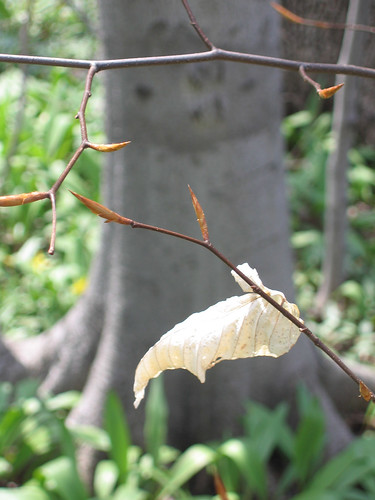
American beech
(Fagus grandifolia). I don't know why, but beech trees hold onto their leaves all winter. They are a welcome splash of color in a winter woodland - and even in spring. Rich forest soils.


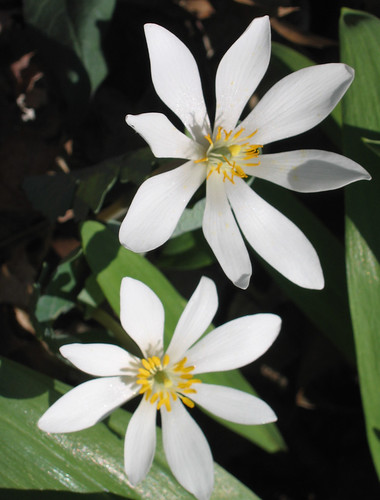
Bloodroot (Sanguinaria canadensis). Pure white. Lovely and fleeting. Rare in NYC.

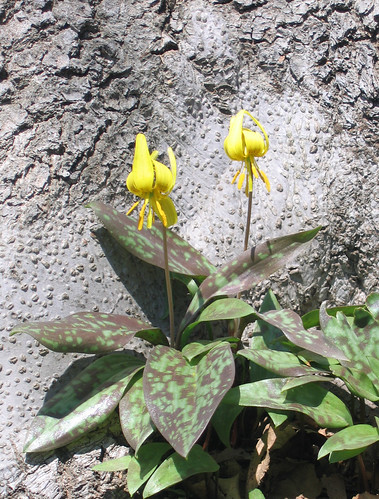
Trout lily (Erythronium americanum). An impressive amount, it just went on and on. These types of shade tolerant species are slow growing, and so such large colonies are very old - the population could've been many decades old.


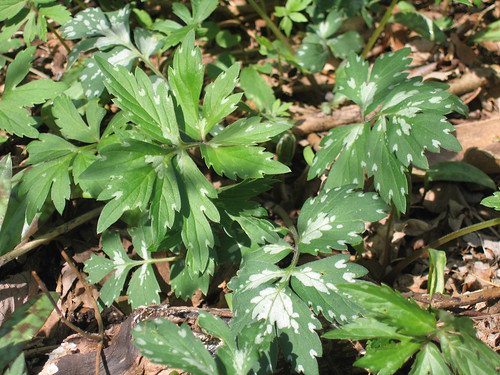
Virginia waterleaf (Hydrophyllum virginianum). Decorative foliage - the silvery spots that look like water stains. I'm surprised this isn't used more in the hort trade. It's a great groundcover. Found in rich forest soils and floodplains. Rare in NYC.

25 April 2005

Gratuitous flower picture


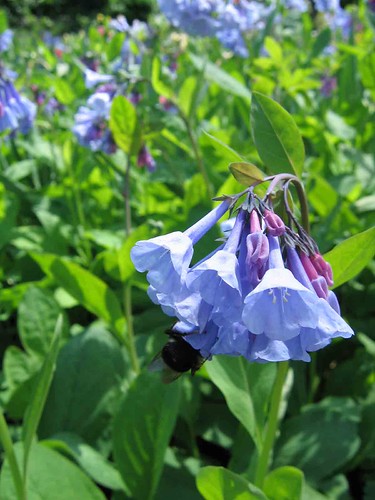
Virginia bluebell (Mertensia virginiana)
I'm in a bluebell state of mind.

21 April 2005

Wildflowers of Pelham Bay Park


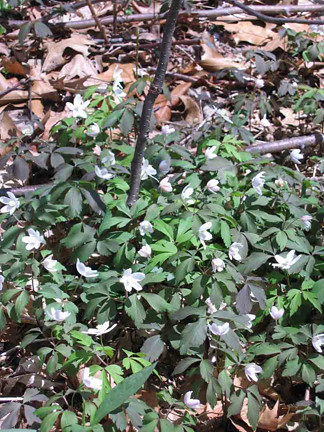
wood anemone (Anemone quinquefolia), a NYC native spring ephemeral

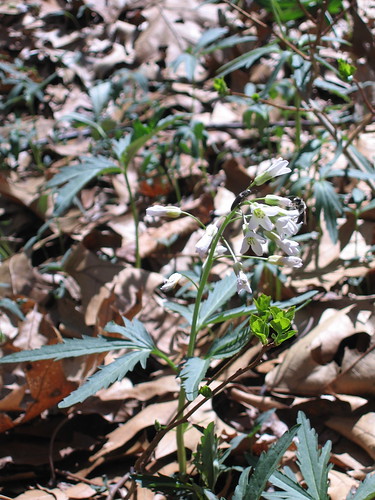
Today was a great day to be in Pelham Bay Park. Spring ephemerals were everywhere! I counted 7 patches/populations of wood anemone (Anemone quinquefolia) (see above), lots of trout lily (Erythronium americanum) and the ubiquitous common blue violet (Viola sororia). Also observed something very interesting - insect visitors to native and exotic flowers. One of the largest patches of cut-leaf toothwort (Cardamine laciniata) had loads of insect visitors. It looked like a Liliputian JFK, with syrphid flies, cabbage whites, beetles (one of which may have been a click beetle), predatory wasps, solitary bees - amazing. Then, a few feet away, began a biological desert - acres and acres of periwinkle (Vinca minor). Walking through this exotic invasive (a fav of homeowners), I saw only 2 bumblebees and one wasp. That's it! Food for thought.

cut-leaf toothwort (another a NYC native spring ephemeral) with beetle visitor (look carefully)

Other plants seen - white bark of gray birch (Betula populifolia), far too much of day lily (Hemerocallis fulva) the popular exotic invasive that is smothering our lovely spring ephemerals, emerging leaves of white oak (Quercus alba) tinged with red, a cabbage white (exotic butterfly) laying eggs on garlic mustard (exotic, invasive plant), the beautiful spring azure (butterfly), a just emerging jack-in-the-pulpit (Arisaema triphyllum), the showy leaves of alum root (Heuchera americana) - finally, a native plant that is popular in the garden.

daylily invading (invaded really) forest understory


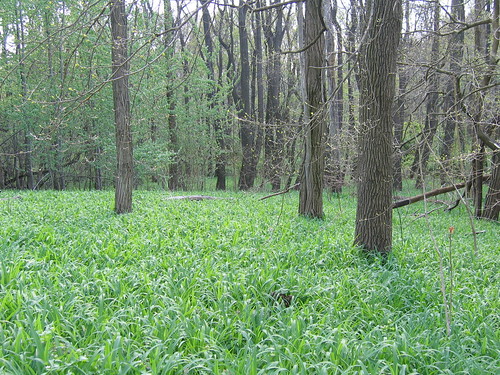
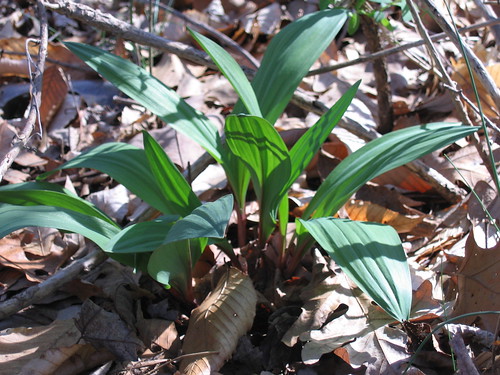
The most exciting find of the day was ramps (Allium tricoccum)...a native spring ephemeral and a new listing for our records!

ramps (Allium tricoccum) leaves - flowers emerge after leaves die back (another NYC native spring ephemeral)

11 April 2005

Spring ephemerals


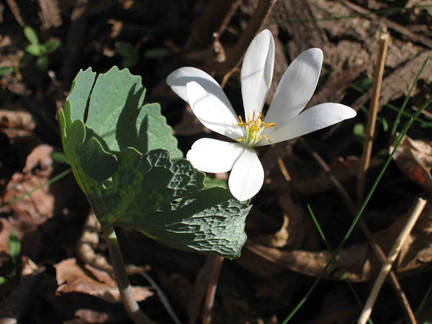
Bloodroot (Saguinaria canadensis) a NYC native spring ephemeral, in Pelham Bay Park in the Bronx
April is the onset of our flowering season, and some of the earliest herbaceous bloomers are called "spring ephemerals." The term is appropriate, since their flowers are fleeting and the plants disappear in the heat of the summer. These species are found in undisturbed moist, rich woods, and have a small window in which to store up nutrients for next year's flowers. Leaf out of canopy trees curtails photosynthesis, so they enjoy full sun early in growing season, and are resigned to shade the rest of year. One of our earliest and loveliest is bloodroot (Saguinaria canadensis). Its porcelain white flowers are open and welcoming to early insect visitors. The leaves resemble large, scalloped satellite dishes, angled to soak up any spare sunlight that finds its way to the forest floor. The most phenomenal display of these lovely plants is in the eponymous Bloodroot Valley in the Staten Island Greenbelt. Here it is locally abundant, but in New York City bloodroot is somewhat rare; found in only six parks. As with other spring ephemerals, its seeds are dispersed by ants. Over a 1000-year period, such seeds may only travel 100 yards from the parent plant. This means the likelihood of recolonizing a forest once the plant has disappeared will happen exceedingly slowly if at all.

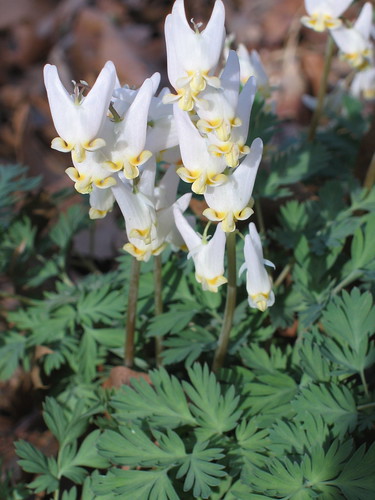
Dutchman's breeches (Dicentra cucullaria), a NYC native spring ephemeral, in Pelham Bay Park in the Bronx
Other New York City spring ephemerals include: wood anemone (Anemone quinquefolia), broad-leaved toothwort (Cardamine diphylla), spring beauty (Claytonia virginica), Dutchman's breeches (Dicentra cucullaria), trout lily (Erythronium americanum), and violets (Viola species).


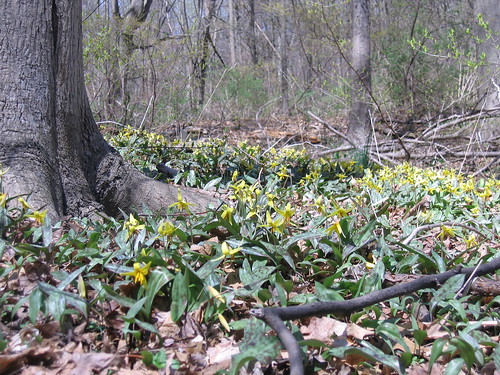
trout lily (Erythronium americanum), another NYC native, covering the forest floor in Pelham Bay Park in the Bronx. Populations this large of the slow growing plant are many decades old.

06 April 2005

Finally spring - Van Cortlandt Park


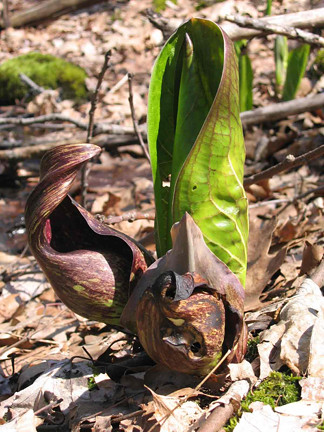
Skunk cabbage flowers & emerging leaves (common NYC native plant)
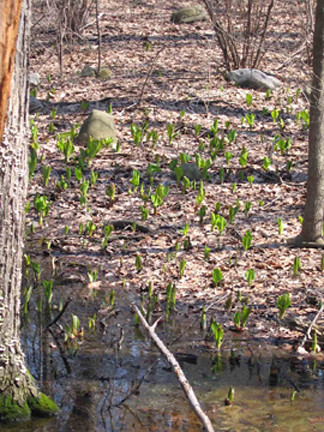
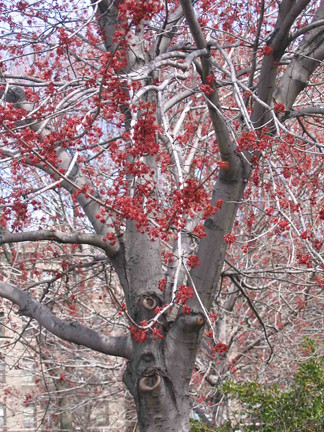
After what felt like an eternity, the wait is over! Skunk cabbage (Symplocarpus foetidus) and red maple (Acer rubrum) flowers! Skunk cabbage is an especially interesting plant. It is a member of the Arum family, whose members are typically found in the tropics. (Another temperate member is Jack-in-the-pulpit). The flower consists of a maroon mottled spathe hiding the reproductive parts called the spadix. The flowers coloration and smell (an unpleasant mixture of dung and rotten meat) attracts some beetles and flies that think it's a dead animals (the preferred places to lay eggs). These insects are excellent pollinators. Invertebrate visitors also get the spa-treatment. In February and March, skunk cabbage flowers are able to poke their way through the winter ground by melting the snowy layer above. Through thermogenesis, the flower is kept at a toasty 70 degrees F. This warm air also helps to disseminate the floral "fragrance".

Swamp forest of skunk cabbage
Certainly, red maples and skunk cabbage have been in bloom for a few weeks now, but I am starting to see other signs of greenery - emerging leaves on both; plus found a patch of trout lily (Erythronium americanum) leaves. These were only about 2" long, so it will be at least a week before flowers appear . Also PA sedge (Carex pennsylvanica) had leaves and immature flowering stems. Lots of aster & solidago rosette leaves starting to emerge, some nice clusters of round-leaved pyrola (Pyrola rotundifolia). A new listing for the park - wintergreen (Chimaphila maculata). The latter two species are encouraging signs of healthy forests.

Flowers of red maple (common NYC native plant)